
The short version
Half the menu is made up of things you have never seen at home.
A rim stuffed with sweet potato mousse, bulgogi, potato and sweetcorn all sit in the standing lineup. A pie runs from under 10,000 won to the mid 30,000s depending on which tier of brand you pick, and for the same pizza, ordering delivery instead of collecting it yourself accounts for about thirty per cent of the price.
Right now
- 1After you pick a pizza you are asked to pick a base and a rim separately. That is where the price grows.
- 2Collecting it yourself takes up to 30 per cent off. The brand's own app is usually cheaper than a delivery app.
- 3The tier of brand sets the price. Under 10,000 won and over 30,000 won exist in the same city.
What to have ready
- The brand's app: Coupons and pickup discounts mostly live inside it and nowhere else.
- Your telecom tier: SK Telecom, KT and LG U+ membership grades knock money off pizza.
- Space in the fridge: Two people rarely finish a large in one sitting.
Phrases you can copy and paste
Step by step
- 1
Read the unfamiliar names on the menu
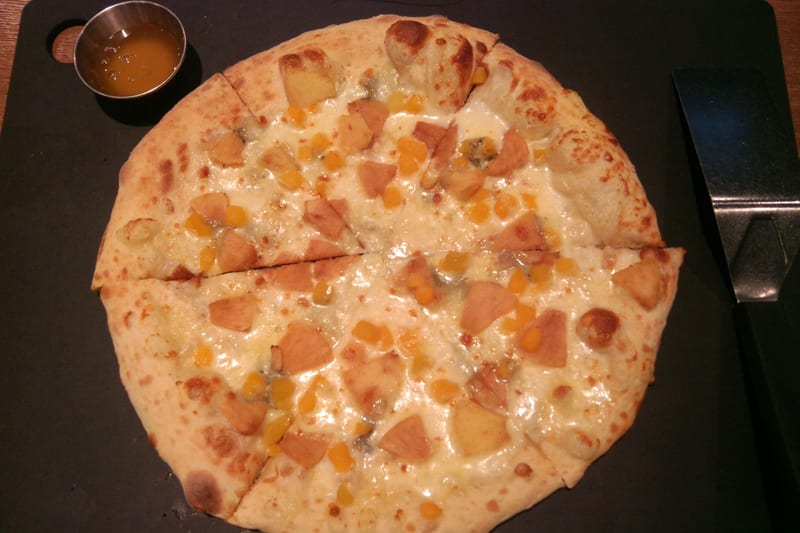
Toppings that never made it abroad are permanent fixtures here. The first is bulgogi, beef marinated in soy sauce, which turns up everywhere from the cheapest chains to the biggest. The second is sweet potato, mashed into a mousse and either spread over the top or piped into the rim with cheese laid over it. The third is potato, sliced thin and dressed with a mayonnaise-based sauce. Sweetcorn and prawns follow close behind. The actual names give you the picture. One large chain's standing lineup includes Real Bulgogi, Uri Goguma (our sweet potato), Potato, Super Deluxe and Super Supreme, while a budget chain lists bulgogi pizza, sweet potato pizza, corn cheese pizza and sweet chilli prawn pizza. Gold in a product name usually signals sweet potato or cheddar.
- 2
The base and the rim are separate choices
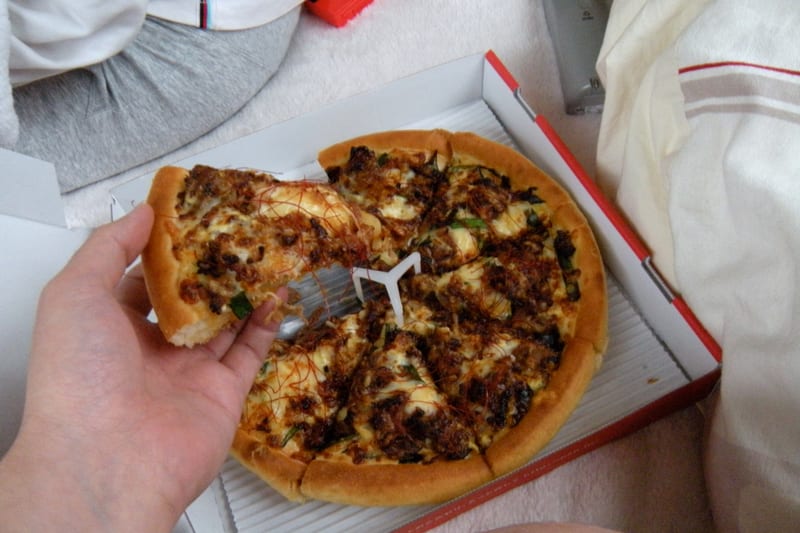
Once the pizza is chosen, a screen asks you to pick a base. Original is the default, with thin, double-layered, multigrain and high-protein versions beside it. Then comes the rim, which Korean chains call the edge: an option to stuff the outer ring that would otherwise be plain crust. What goes inside is double cheese, triple cheese, pepperoni, a cream cheese variant, or sweet potato mousse. One chain scatters streusel crumbs over the rim or rings it with cheese instead. Each of these choices adds a few thousand won, which is generally why the price in the advert and the price at checkout differ. The oldest item in this family is Rich Gold, launched in 2003: the cheese-crust roof was taken off to expose the cheese, with golden cheddar and sweet potato alongside. By 2012 it had sold 50 million pies.
- 3
Brands come in three price tiers
At the top are the large chains. Domino's Pizza, Pizza Hut and Papa John's belong here. A large runs from the mid 20,000s to the high 30,000s, delivery and store pickup both work, and app and partner discounts are dense. Mister Pizza held a place in this tier through the 1990s and 2000s but has shrunk a great deal, so depending on the neighbourhood there may not be one. The middle tier is home-grown: Banolim Pizza, Pizza Alvolo, Chungnyun Pizza and others, cheaper than the big chains and competing on how much they pile on. The bottom tier is takeaway-first and cheap. Pizza School starts at 8,900 won for cheese, 9,900 for pepperoni, 10,900 for combination and sweet potato, 11,900 for bulgogi and potato, and tops out at 15,900. Pizza Maru sits at the same level. This tier is built around you coming to collect, so some branches do not deliver at all or charge separately for it.
- 4
Work out how to buy a portion for one
A large is too much for one person. There are a few ways around it. One is half and half: the bigger chains will bake one pie as two different pizzas, which is a good way to try an unfamiliar topping without committing. The second is single-serving oven pizza. GOPIZZA bakes at one-person size by design, and Pizza Maru has an eight-inch personal pizza, including a 9,900 won box that pairs one with chicken skewers. The third is frozen. Supermarkets, convenience stores and online shops all sell frozen pizza that goes straight into an oven or air fryer, at a fraction of delivery prices, and some products copy the delivery format down to the cheese-stuffed rim.
- 5
How you order is what sets the price
The most expensive way to buy a given pizza is at full price through a delivery app. Reorder the steps and the price falls a long way. First, collect it yourself. One large chain takes up to 30 per cent off for store pickup, with the rate varying by branch. To quote the example on its own price notice, a medium cheese pizza at 16,500 won comes to 11,550. Second, order through the brand's own app or website, since coupons and pickup discounts generally live only there. Third, check your telecom membership, which is worth between 15 and 30 per cent depending on grade. Fourth, look at card partnerships: some cards take around 20 per cent off, others clear the bill with points instead. Whether these stack is up to each brand, so read the final figure on the payment screen once before you confirm.
- 6
Know what arrives alongside the pizza
A Korean pizza order comes with a few things in the bag. The one that surprises people most is pickled cucumber, sharp and sweet, handed over by almost every shop to cut through the grease. Next is garlic dipping sauce, garlic and butter, meant for dunking the rim, though some bases come without it. The notice states outright that choosing the double-layered base means no garlic dip. On top of that come chilli sauce and cheese powder, and a set order brings a bottle of cola. Ask for more and you usually get it. Extra pickles are free in many places, while extra sauce is sometimes charged for.
Watch it happen
Videos other people made, picked because they show a part of this guide that words cannot. They are not our sources: the rules and figures above come from the official pages listed at the end.
(ENG) 대한민국 3대 피자🍕허리피자 어깨피자 박명수가리뷰한피자 | 도미노 피자헛 파파존스 잭슨 노모어 피자스쿨 알볼로 청년피자 반올림 | 할명수 ep.256
Channel: 할명수, Korean, with English and Japanese subtitles
Ten of the chains this guide names are opened and compared in one sitting, which shows the price tiers as sizes and toppings rather than as a list.
The Korean words
- 도우dou, dough base
- The first thing you choose after picking the pizza.
- 엣지etji, stuffed crust rim
- The option to fill the outer rim with cheese or sweet potato. It costs extra.
- 라지 / 미디엄raji / midieom, large / medium
- Korean chains generally sell these two sizes only.
- 방문포장bangmun pojang, store pickup
- Collecting it yourself. The single biggest discount on the order.
- 반반banban, half and half
- One pie baked as two different pizzas. Also written as half-and-half.
- 피클pikeul, pickled cucumber
- Comes with the pizza. Ask and you will usually get more.
- 갈릭 디핑 소스gallik diping soseu, garlic dipping sauce
- Given for dunking the crust rim.
Easy to miss
- Advertised prices assume the standard base. Changing the base or the rim pushes the total up at checkout.
- Choosing the double-layered base means no garlic dipping sauce. If the sauce is the point, pick a different base.
- Pickup discount rates differ by branch. The same brand one neighbourhood over may take more off.
- Budget chains often price on the assumption you are collecting. Some do not deliver, and others add a separate fee.
- Gold in a product name usually means sweetness is involved. Order it expecting a savoury pizza and you will be caught out.
You can skip this if
- If what you want is a thin, restrained Neapolitan pie from a wood oven, look at independent pizzerias rather than the chains. The chain default is heavy toppings and a thick rim.
- If you want a single slice, chain branches generally sell by the whole pie. Places that sell slices have to be sought out.
When it is time for a person
- If you are putting together a gathering, a work dinner or a housewarming, someone who can size the order to the headcount and the budget takes the guesswork out of it.
Where this comes from
- Pizza menu and prices (Domino's Pizza Korea, retrieved 22 August 2026)
- Discounts and partner offers (Domino's Pizza Korea)
- Menu (Pizza School, retrieved 22 August 2026)
- Menu (Banolim Pizza)
- Menu (Pizza Maru)
- Pizza Hut Rich Gold passes 50 million pies sold (Asiae report, 10 February 2012)
- Pizza Hut Korea marks 40 years with a 1985 campaign (Newswire press release)
Rules, fees and deadlines change and depend on your exact case. Please confirm the details with the official sources before you act.