
The short version
The yellow emart sign belongs to five different shops: the big-box E-mart, warehouse-style Traders, neighbourhood supermarket Everyday, own-brand specialist No Brand, and the convenience store emart24.
The first four have two closing days a month and mostly stay shut before 10am. The 24 in emart24 is not a promise about opening hours. The word after the sign tells you the shop type, and reading it keeps you from standing at a locked door.
Right now
- 1Planning a Sunday grocery run, check that branch's closure days first. Many areas close on the second and fourth Sunday.
- 2Drop the hypermarket from any morning plan. Doors mostly open at 10am.
- 3Read the word after the sign. 24 means convenience store, Traders means warehouse, Everyday means neighbourhood supermarket.
What to have ready
- A shopping bag or backpack: Store bags cost money. The bigger the shop, the more it pays to bring your own.
- The passport itself: Some branches run a tax refund counter. Where there is one, the refund happens on the spot against your passport.
- The branch name: Closure days and opening hours differ branch by branch. The official site searches by branch name.
Phrases you can copy and paste
Step by step
- 1
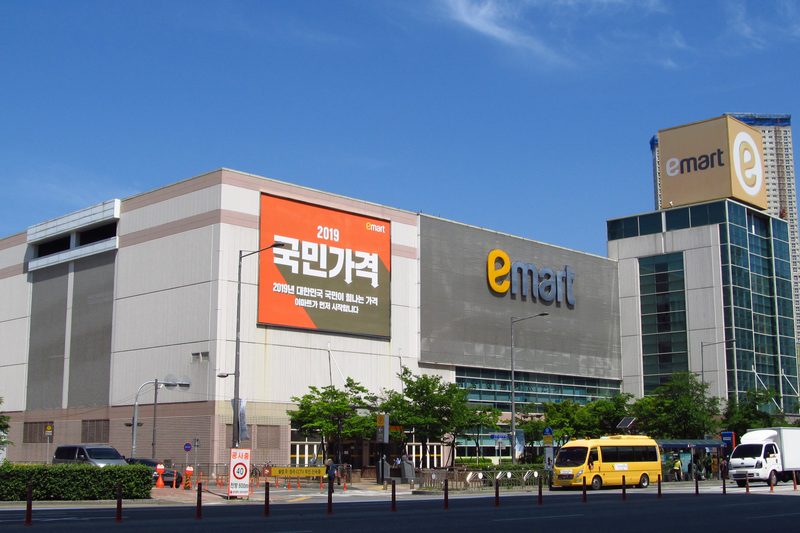
Five signs, one line each
They all belong to the Shinsegae group and the logos look alike, so at first they read as one shop. E-mart is the big-box store with everything from food to appliances. Traders is its warehouse version, selling bulk bundles by the crate. E-mart Everyday is the size of a neighbourhood supermarket. No Brand is a specialist store selling only the group's own-brand products, and emart24 is the convenience store. For a traveller the sorting is simple: the big shop for the big haul, emart24 for whatever is urgent, and Everyday and No Brand sit in between. Traders is closer to sightseeing unless you plan to grow your luggage without limit.
- 2
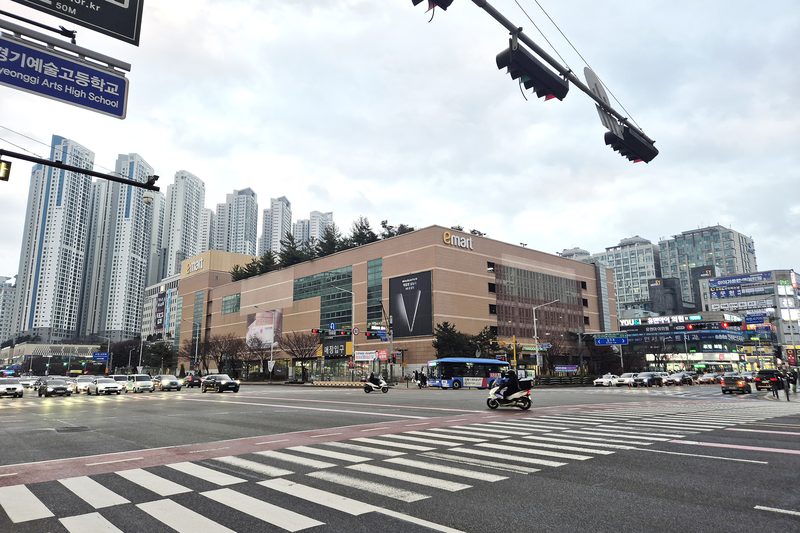
Twice a month, the doors stay shut
Korean hypermarkets and corporate supermarkets fall under a law that lets local governments designate two mandatory closing days per month, and most areas have done so. The rule says the days come from public holidays, which makes the second and fourth Sunday the most common pattern, but a district that reaches agreement with local merchants can move them to a weekday, so some areas close on Wednesdays instead. Even within Seoul it differs by district. The rule covers not just E-mart but Everyday and the standalone No Brand stores too. So before heading to a store, look its branch up in the official directory, where this month's and next month's closure dates are written out.
- 3
Nothing happens before 10am
The same law allows business hours to be restricted between midnight and 10am, and in practice Seoul E-mart branches commonly run from 10:00 to 23:00. A last grocery run before a morning flight tends to fall apart for exactly this reason. The early hours belong to convenience stores and small supermarkets. The upside is the late end of the day: shopping after your evening plans is where the hypermarket has room.
- 4
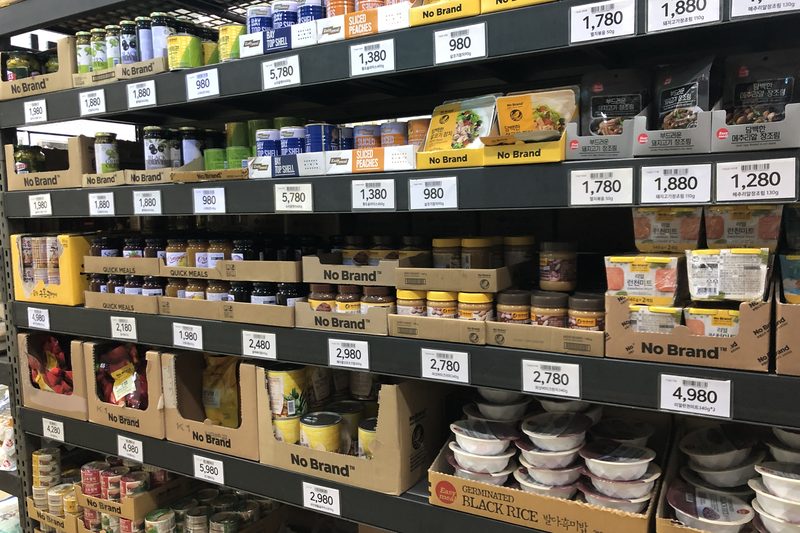
No Brand shelves price out the brand
When you walk into a shop walled with yellow boxes that say nothing but No Brand, that is the place. It is E-mart's own label, and the price drops by roughly what packaging and advertising would have cost. Snacks, canned food, instant rice and household basics are the core, and it exists both as shelves inside E-mart stores and as standalone specialist shops. The plain packaging makes for a dull gift, but for stocking what you will eat and use at your accommodation, this is the shelf where the same money carries furthest. Just remember the standalone stores appear on the same mandatory closure list.
- 5
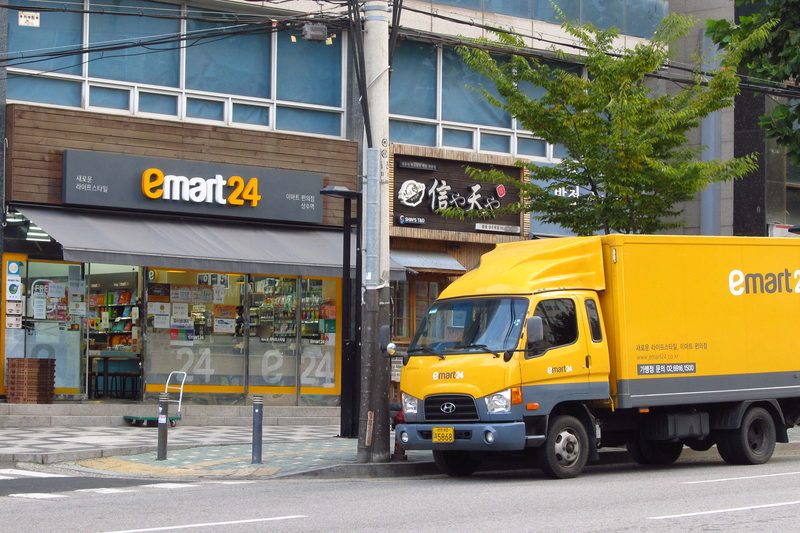
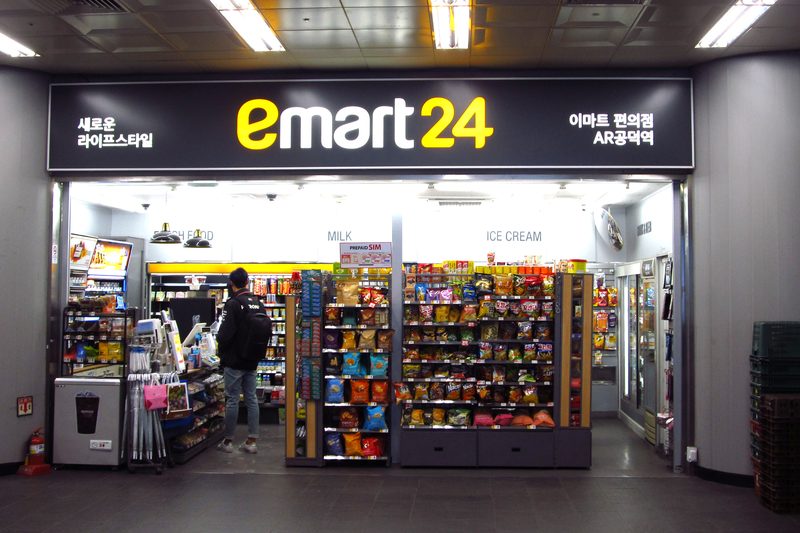
The 24 in emart24 is not a schedule
The name suggests a 24-hour shop, but emart24 franchisees set their own hours, and at night some stores switch to staffless mode or simply close. The company itself advertises a hybrid format built for unmanned overnight operation. If you head there late, factor in that a lit storefront may be in its staffless window, and during those hours alcohol and cigarettes cannot be sold. For the shared convenience store skills, checkout, parcels, transit card top-ups, see the convenience store guide.
- 6
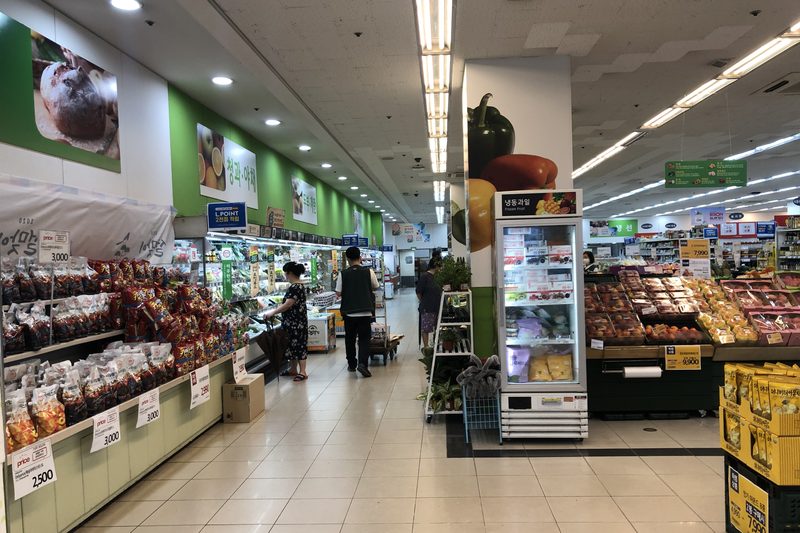
Big hauls at the mart, tax back at the counter
If gim, ramyeon and snacks are on your list, the mart beats the convenience store on price every time; within the same group, convenience store prices sit above mart prices. And depending on the branch, there may be a tax refund counter for foreign shoppers. Some branches, Sinchon among them, state on their floor guide that refunds apply from 15,000 won. Check where the customer service desk is before you pay. What is genuinely cheaper in Korea and what is not has its own guide.
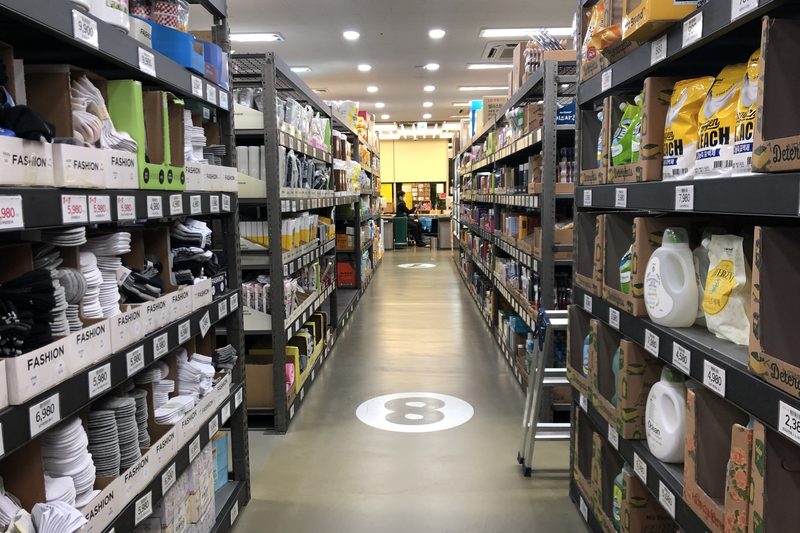
Watch it happen
Videos other people made, picked because they show a part of this guide that words cannot. They are not our sources: the rules and figures above come from the official pages listed at the end.
4K Korean Supermarket Shopping Tour in Seoul - E-MART Yongsan Branch in I'Park Mall
Channel: Walking On, No narration, ambient sound
It walks both floors of one E-mart, from the food aisles to clothes, furniture and stationery, so the range behind the word hypermarket is something you see rather than read.
NO BRAND KOREA TOUR 🛒🇰🇷 No Brand Burger 🍔🍟 Korean Grocery Store 노브랜드
Channel: Hmong Yeoja , English narration, auto-generated English subtitles
The camera moves through a standalone No Brand store, so you can see shelves of plain yellow own-label packaging where a normal aisle would carry brands.
WHOLESALE GROCERY SHOPPING IN SOUTH KOREA| TRADERS WHOLESALE CLUB
Channel: Derrickson Dynasty, English narration, auto-generated English subtitles
A whole grocery run at Traders, aisle by aisle, so you can see the size the packs come in before you decide whether the warehouse store suits what you can carry.
The Korean words
- 휴점일hyujeomil, store closure day
- Posted as dates at the entrance and on the official site.
- 의무휴업uimu-hyueop, mandatory closing
- Means the closure is set by law. Common on notices at mart entrances.
- 몇 시까지 해요?myeot si-kkaji haeyo?, until what time are you open
- Asks the closing time. For opening time, swap kkaji for buteo.
- 창고형changgo-hyeong, warehouse style
- Describes bulk stores like Traders.
- 시식sisik, free tasting
- Tasting stands appear in food aisles on weekends. If offered, help yourself.
- 행사 상품haengsa sangpum, promotional item
- A discounted or bundled item, usually flagged by a differently coloured shelf tag.
- 무인muin, staffless
- Self-checkout only, no staff present. A frequent sight at emart24 overnight.
Easy to miss
- Standing at a closed mart on the second or fourth Sunday is the classic failure. Everyday and standalone No Brand stores can be shut the same day.
- Trusting the 24 and arriving at night can land you in the staffless window, where alcohol and cigarettes are not sold.
- A before-10am mart run simply does not exist in many areas. Move a departure-day shop to the night before.
- Pick up one snack bag at Traders and a whole case comes with it. Warehouse shelves often do not sell singles.
- Closure days are set per branch. The branch that was open yesterday says nothing about the one you are visiting today.
You can skip this if
- If what you want is how to send parcels or top up a transit card at a convenience store, the convenience store guide is the answer, not this one.
- On a one or two day itinerary you may never need a hypermarket. The convenience store and Daiso near your accommodation often cover it.
When it is time for a person
- Once weekly grocery runs become your life, the real question is which of these signs is cheapest in your neighbourhood. The answer differs street by street, and someone who has lived there answers it fastest.
Where this comes from
Rules, fees and deadlines change and depend on your exact case. Please confirm the details with the official sources before you act.