
The short version
The color tells you half of what you need.
Blue and green stay in the city, red runs to Gyeonggi-do, N means night. You tap a card on and off just like the subway, and quite a few routes no longer take cash at all.
Deadlines that matter
The stop button
By when: When your stop is announced
If you miss it: If nobody presses it, the driver may assume no one is getting off and skip the stop. If that happens, get off at the next one and walk back.
Transfer discount
By when: Within 30 minutes of tapping off (60 minutes from 9pm to 7am)
If you miss it: The fare starts over from scratch. Getting back on a bus with the same route number never counts as a transfer in the first place.
Right now
- 1Put your destination into a map app and check the bus number and the stop name. It also counts down the minutes until the bus arrives.
- 2Board through the front door and tap your card. To get off, press the stop button, then tap again at the reader by the rear door.
- 3Many routes take no cash, so top up your transit card before you ride.
What to have ready
- A prepaid transit card: The same card you use on the subway. Top it up at a convenience store if the balance runs low.
- A map app: Naver Map or KakaoMap. Both show which stop to use and how many minutes until the bus arrives, in real time.
- The name of your stop: A screen inside the bus shows the next stop. Knowing the name in advance means a missed announcement will not throw you.
Phrases you can copy and paste
Step by step
- 1
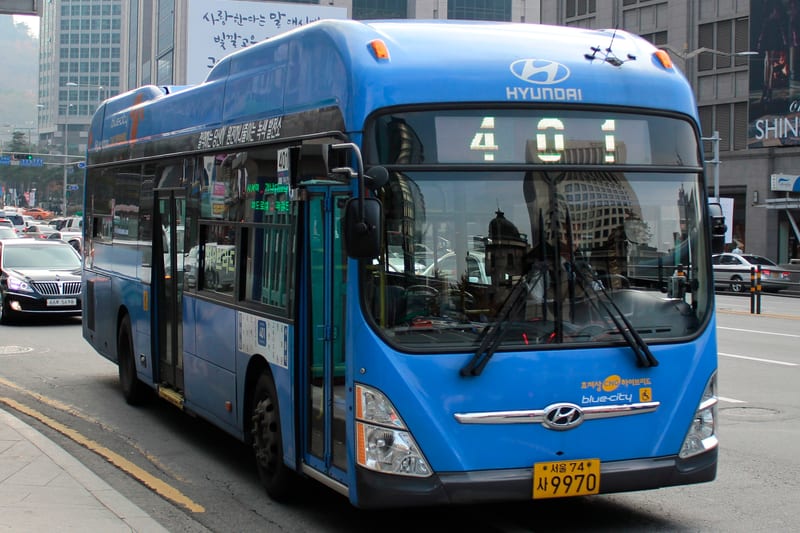
The color does half the reading for you
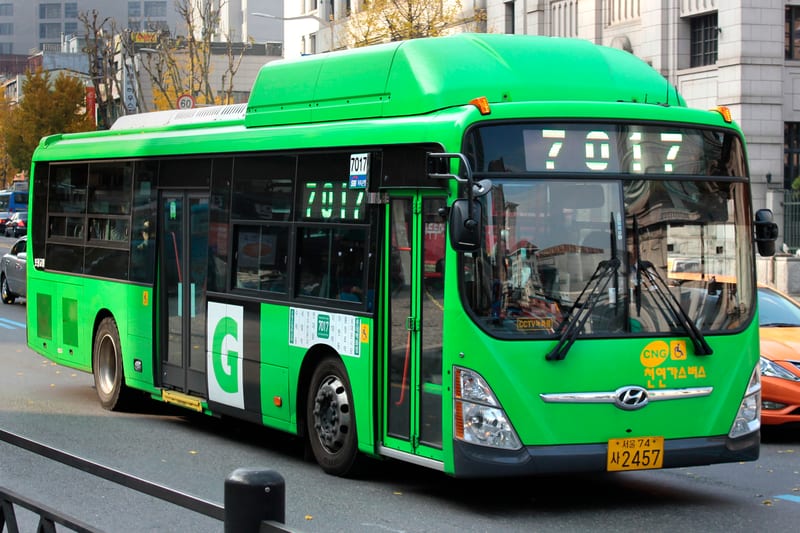
Blue buses (trunk routes) run long lines between the city center and outer districts, and green buses (branch routes) connect subway stations with neighborhoods. Both cost 1,500 won by card. The small green ones are village buses, which loop through a neighborhood for 1,200 won, and yellow circulation buses run short loops downtown for 1,400 won. Red buses (metropolitan routes) cross into Gyeonggi-do and jump to 3,000 won. Night buses, numbered with an N, cost 2,500 won. All of these are adult card fares, and the first ride before 6:30am gets a 20% early-bird discount. Route numbers have two to four digits that encode where a route starts and ends, but there is no need to memorize any of it. The app tells you which number to catch.
- 2
The stop screen counts down arrivals
Every stop has a name and its own ID number, and larger stops have arrival screens showing which buses come in how many minutes. Several routes share one stop, so check the number as the bus approaches. When a few buses pull in at once, raise a hand lightly as yours appears so the driver knows to stop for you. Map apps show the same arrival data in real time, so a small stop without a screen is nothing to worry about.
- 3
You board through one door and leave through another
Board at the front door and tap your card on the reader. As of January 2026, 183 routes carry no cash box at all, so cash simply cannot be paid there, and even on routes that still take it, the card is much faster. When your stop comes up, press the stop button, tap your card again at the rear door reader, and step off. That exit tap feeds both the transfer discount and the fare calculation, so it matters as much as it does on the subway.
- 4
The fare adds up across your whole trip
With one card, transfers between buses and the subway are charged by the total distance of the journey, not per vehicle. The base fare covers 10km, and every 5km after that adds 100 won. You need to board the next vehicle within 30 minutes of tapping off (60 minutes from 9pm to 7am), and up to four transfers count in one journey. The details are in the subway guide; the one extra rule for buses is that reboarding the same route number is a new fare, not a transfer.
- 5
When the last train is gone, there is the N bus
- Cost:
- 2,500 won by card
Night-only buses with route numbers starting with N run on 14 routes as of March 2026. Schedules vary by route, but most start their first runs around 11pm and keep going until roughly 3 to 4am, with longer gaps between buses than daytime, so watch the bus location in the app before walking to the stop. If you are heading back from a night out in Hongdae or Gangnam, it is worth checking before you call a taxi.
Watch it happen
Videos other people made, picked because they show a part of this guide that words cannot. They are not our sources: the rules and figures above come from the official pages listed at the end.
서울시내버스 이용 꿀팁! 자주 묻는 질문 BEST4!! 버스 환승 제대로 알기
Channel: 서울시버스운송사업조합, Korean, no English subtitles. The value is the diagrams
Made by the association that runs Seoul's buses, and it answers the four questions passengers ask most, transfers among them, with the fare rules drawn rather than described.
The Korean words
- 정류장jeongnyujang, bus stop
- Where the bus stops. Signs sometimes write it as jeongnyuso.
- 하차벨hacha-bel, stop button
- The button that tells the driver you are getting off. On poles and window frames.
- 간선버스ganseon-beoseu, trunk bus (blue)
- Blue. Runs long lines between the center and outer districts.
- 지선버스jiseon-beoseu, branch bus (green)
- Green. Connects subway stations with neighborhoods.
- 마을버스maeul-beoseu, village bus
- A small green bus looping through one neighborhood. Slightly cheaper.
- 막차makcha, last bus
- The last run of the day. The time differs by route.
Easy to miss
- Trying to board through the rear door. Front to get on, rear to get off is the default.
- Standing there without pressing the stop button. If nobody seems to be getting off, the bus passes the stop without slowing down.
- Forgetting to tap off. It breaks your transfer chain and throws off the fare.
- Carrying only cash. As of January 2026, 183 routes have no cash box.
- Transferring to a bus with the same number. Reboarding the same route never counts as a transfer.
- Expecting city-bus fares on a red bus. Metropolitan buses charge 3,000 won by card.
You can skip this if
- Airport limousine buses use a different fare system from city buses. Getting to and from the airport has its own guide.
- Buses licensed in Gyeonggi-do and Incheon use different colors and fares. This guide covers Seoul-licensed city buses.
When it is time for a person
- Once your commute settles into a routine and you want to plan route combinations and monthly costs properly, working it out with someone who knows the city is faster.
Where this comes from
Rules, fees and deadlines change and depend on your exact case. Please confirm the details with the official sources before you act.