
The short version
Find the color of the line you are changing to and follow it, and you are done.
You almost never pass through the gates again, and even boarding in the wrong direction costs nothing if you fix it within 15 minutes.
Deadlines that matter
Re-entry at the same station
By when: Within 15 minutes of tapping off
If you miss it: You pay a fresh base fare. Tap back in at the same station within 15 minutes and it is treated as one transfer instead, at no charge. In effect since 7 October 2023 on lines 1 to 9, the Ui-Sinseol line and the Sillim line.
The last transfer of the night
By when: Before the last train of the line you are changing to
If you miss it: You cross the transfer corridor and find no train to catch. Late at night, trust the route and times the map app calculates.
Right now
- 1A map app's directions show you the transfer station and even the best car to ride in. There is no need to memorize the whole map.
- 2Once you are off the train, find the color and number of your next line on the transfer signs and follow them.
- 3Boarded the wrong direction? Get off at the next station and go back from the opposite platform. Even where you must exit the gates, re-entering within 15 minutes costs nothing.
What to have ready
- A subway map: This guide carries the official Seoul Metro map. Save it and you can check it even when the signal drops underground.
- A transit card: The transfer discount applies when one person rides on one card. Single journey tickets get none of it.
- A map app: Naver Map and KakaoMap both tell you which car puts you closest to the transfer corridor.
Phrases you can copy and paste
Step by step
- 1
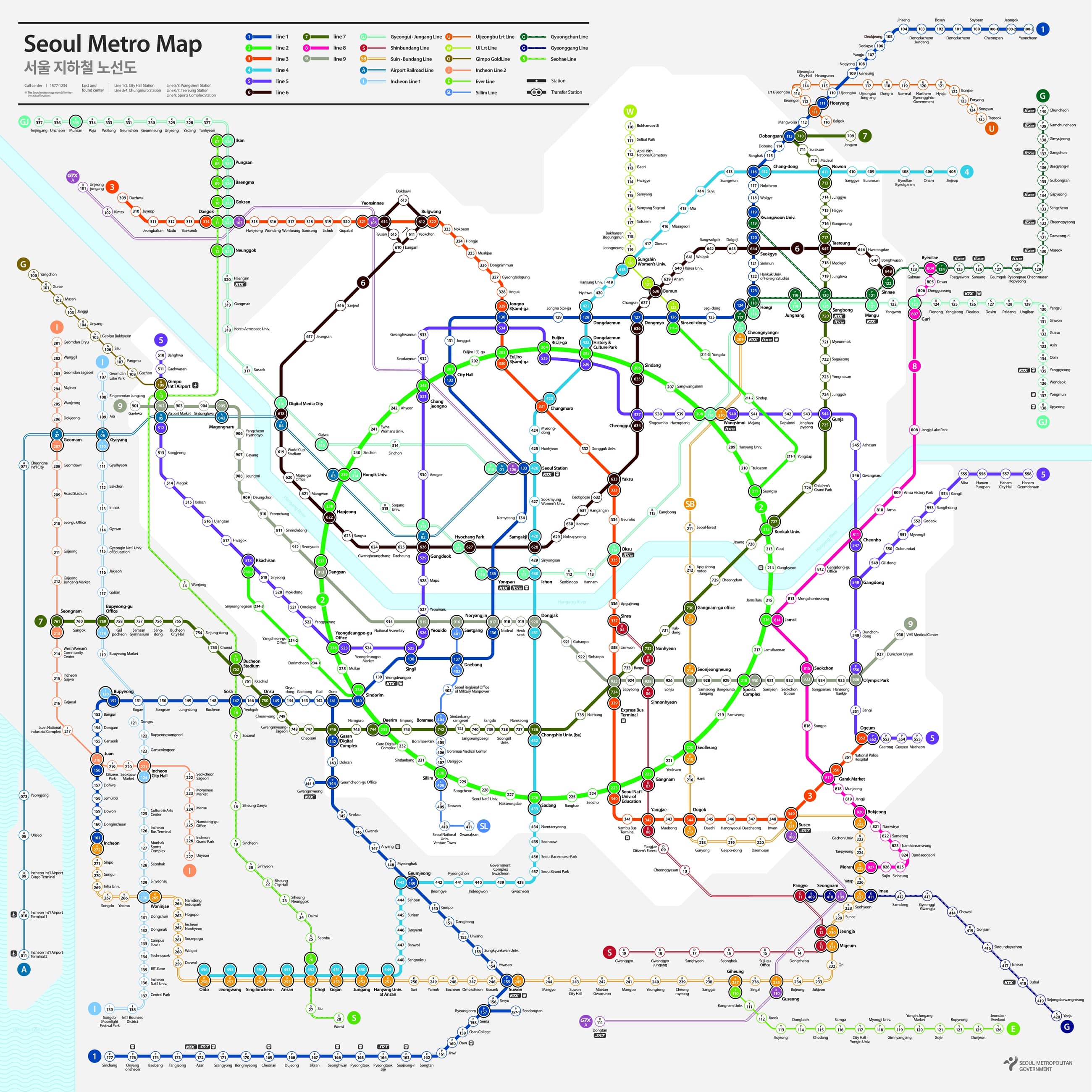
The map is a code of colors and numbers
Every Seoul subway line has its own color. Lines 1 to 9 go by number, and the rest, like the Airport Railroad or the Gyeongui-Jungang line, go by name. Stations carry numbers too, so if a name is hard to read you can navigate by digits instead. Wherever two lines meet at one station on the map, that station is a transfer point. The map above is the official September 2025 edition that Seoul Metro publishes under the Korea Open Government License Type 1. Tap it to zoom, and feel free to save it.
- 2
Follow the transfer signs and nothing else
Off the train, the platform signage splits two ways. One set of signs points to the exits, the other, marked 갈아타는 곳, leads to other lines. Follow the arrows carrying the color and number of your next line and you reach the next platform without ever passing the gates again. In big stations the corridor alone can take several minutes to walk, so never plan a transfer as if it takes zero time.
- 3
The right car cuts the walking
Which car you ride decides how far you walk to the transfer corridor. When you search a route, Naver Map and KakaoMap both display the best car number for a quick transfer. At rush hour that car is also the most crowded one, so if you are not in a hurry, the next car over loses you very little.
- 4
Undoing a mistake without paying again
If you went the wrong way or missed your station, get off at the next stop and cross to the opposite platform. Some stations separate the two directions with gates, forcing you outside first, but tapping back in at the same station within 15 minutes counts as one transfer instead of a new base fare. The same trick covers a quick trip to a restroom that happens to sit outside the gates.
- 5
Same name, not always the same station
A few stations share a name across lines without being connected. Sinchon on line 2 and Sinchon on the Gyeongui-Jungang line are separate stations a long walk apart. If the app's route shows a walking leg instead of a transfer, it means walking outside the station, so budget the time and check the weather.
Watch it happen
Videos other people made, picked because they show a part of this guide that words cannot. They are not our sources: the rules and figures above come from the official pages listed at the end.
Seoul Subway Ride and Line Transfer | South Korea
Channel: Johnny Strides, No narration. Auto-generated English subtitles
One ride from Wangsimni to Myeongdong with a line change in the middle, filmed without cuts, so you can see how long the walk between platforms really takes.
The Korean words
- 갈아타는 곳garataneun got, transfer
- The sign wording that marks a transfer corridor.
- 나가는 곳naganeun got, exit
- Signs toward the exits. Exits go by number.
- 타는 곳taneun got, platform
- The platform. Numbered, as in platform 3.
- 방면bangmyeon, bound for
- Marks a train's direction by its terminus or a major station.
- 환승역hwanseung-yeok, transfer station
- A station where two or more lines meet.
Easy to miss
- Following the crowd instead of the signs. At rush hour the crowd may be heading for the exits, not the transfer corridor.
- Planning a transfer as zero minutes. In big stations the corridor alone is a real walk.
- Hesitating outside the gates after getting off at the wrong stop. Past 15 minutes, the free re-entry is gone.
- Assuming a shared name means a connection. Like Sinchon, some same-name stations sit on different spots entirely.
- Picking a route with many transfers late at night. One missed connection leaves you finding your way home from that station.
- Carrying a map that is years old. Every new line changes the edition, so check when it was published.
You can skip this if
- The discount rules for switching between subway and bus are covered in the basic subway guide. This one is about changing lines inside the subway.
- Changing onto separately priced lines such as Shinbundang or GTX can add to the fare. Check the official fare page for amounts.
When it is time for a person
- When your regular route is set and the question shifts to passes and shaving minutes off the commute, sorting it out with someone who knows Seoul's geography saves time.
Where this comes from
Rules, fees and deadlines change and depend on your exact case. Please confirm the details with the official sources before you act.