
The short version
If the sign registers the place as a singing practice room, the law bans both alcohol and hostesses there, so nothing can be added to the bill beyond the room.
A place that sells alcohol is not a noraebang but a bar, and its pricing is a different world. Once you know that one distinction, getting a room takes a few minutes whether you are alone or in a group.
Right now
- 1Read the sign. If it contains the words singing practice room, the place is for singing only, with no alcohol. If it says bar or karaoke, it is a different business where drink and hostess charges are added.
- 2Alone or with one other person, go to a coin noraebang. Walk into a booth, feed in a bill or tap a card and you have started. There is no counter to book a room at.
- 3Look up the numbers of the songs you want before you go. TJ and Kumyoung machines use different numbers, so check the logo on the screen as soon as you enter the room.
What to have ready
- A few 1,000 won bills: Coin noraebang machines take bills by default. Some have card readers and some do not, so cash is the surest.
- A list of song numbers: Search the TJ Media and Kumyoung sites in advance and save the numbers in a note on your phone. Time spent searching inside the room is money spent.
- ID: The owner of a singing practice room can ask for ID to check your age and can refuse entry if you cannot show one. An Alien Registration Card (ARC) or a passport will do.
- Water: A singing practice room cannot sell alcohol, and some sell soft drinks while others do not. Your throat dries out fast, so bring some in.
Phrases you can copy and paste
Step by step
- 1
The sign is the business type
Singing practice room is a business category defined by law. The Music Industry Promotion Act (음악산업진흥에 관한 법률) defines the singing practice room business as letting customers sing to an accompaniment machine with no live musician, and requires registration with the mayor, county head or district head before opening. The facility standards in the Enforcement Rule say the trade name must be registered as such and such singing practice room, and the sign must carry that registered name. So even when the sign only says noraebang and the words singing practice room are nowhere on it, a properly registered shop has singing practice room on its registration certificate, and that certificate has to be posted where customers can see it. A place that sells alcohol is not in this category. The Enforcement Decree of the Food Sanitation Act (식품위생법 시행령) classifies a place that mainly sells alcohol and lets customers sing as a singing bar (단란주점), and one that may also have hostesses or a dance floor as an entertainment bar (유흥주점). If the sign says karaoke, room or bar, that is where you are. The two worlds part ways at the facility standards. A singing practice room has to be fully partitioned from any food business with its own entrance, must have a transparent window of at least 1 square meter on the wall facing the corridor, and may not have locks on the room doors. A room that can be seen into from outside is the shape the law demands.
- 2
Why there is no alcohol in a noraebang
Article 22 of the same Act pins down what a singing practice room operator must observe. On the list: do not sell or serve alcohol, do not hire or procure hostesses of either sex, and do not solicit customers. The compliance rules in the Enforcement Decree go a step further and also ban storing alcohol on the premises and turning a blind eye to customers bringing their own in. Nobody may, for money, drink with customers in a singing practice room or liven things up with song and dance, and nobody may introduce such a person either. The penalties are heavy. An owner who hires or procures a hostess faces up to 3 years in prison or a fine of up to 30 million won. An owner who sells alcohol or admits minors outside the permitted hours faces up to 2 years in prison or a fine of up to 20 million won. These provisions matter to foreigners for one reason. If someone approaches you on the street, suggests a noraebang and leads you somewhere with alcohol and a person attached to your table, that shop is not a singing practice room. It is an entertainment bar where the room, the drinks and the hostess are billed separately. Soliciting is itself banned for singing practice rooms, so the fact that someone is pulling you in is reason enough to doubt the business type. This guide is about singing practice rooms, and this step is how you stay on the right side of that line.
- 3
Pricing is either per song or per room
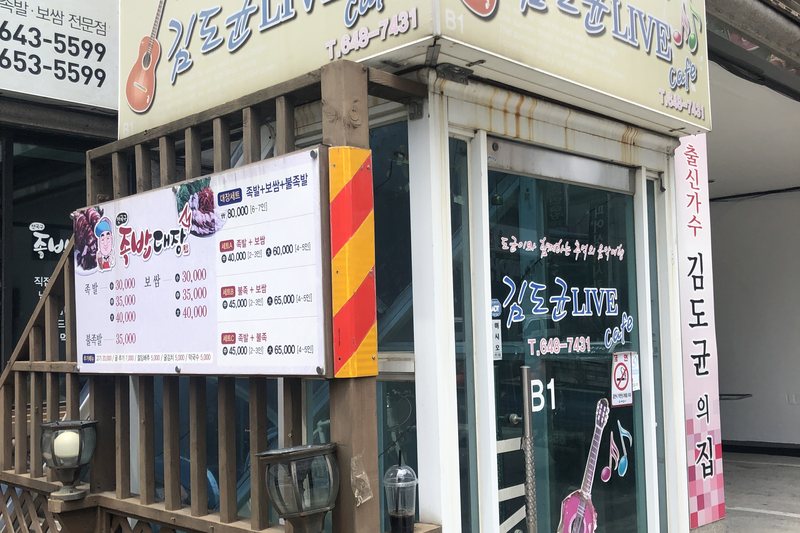
There is no nationwide price list. Singing practice room prices are set by each owner, and if a trade association fixes the price for an area, that decision is itself a breach of the law. In January 2024 the Fair Trade Commission (공정거래위원회) issued a corrective order against the Pohang Singing Practice Room Business Association (포항시노래연습장업협회) for setting the basic fee of member shops, and the decision spells out the two ways prices are set. Coin singing practice rooms charge per song, and ordinary singing practice rooms charge a basic fee per room. In the Pohang market the decision examined in early 2022, coin shops charged anywhere from 250 to 500 won a song, with 3 songs for 1,000 won as the average. The association resolved to raise that to 2 songs for 1,000 won and withdrew the resolution during the investigation. It also tried to raise the ordinary noraebang basic fee from about 20,000 won to 25,000 won. Four years have passed since then and other cities charge other prices, so do not take these numbers with you. Look instead at what moves the price. In a coin noraebang, the money you put in buys a matching number of songs. In an ordinary noraebang you buy time in a room, so the price board lists time of day and room size as its axes, and that board hangs in front of the counter or at the entrance. Read it before you take a room, and check at the same time whether day and night rates differ.
- 4
Take a room, or just walk in
An ordinary noraebang starts at the counter. Say how many of you there are and how long you want, and you get a room number. Most places take payment when you leave, but some take it first, so ask on the spot to avoid confusion. Microphones are in the room, and the Enforcement Rule tells the owner to disinfect them or fit them with covers, and to change the cover every time the customer changes. A coin noraebang has no counter, or none you need to stop at. Walk down the corridor of small booths, pick one that is dark and empty, close the door, and it is yours. Feed 1,000 won bills into the slot on the machine and the song count on the screen goes up. If a card reader is attached, tap it and choose an amount. The Enforcement Rule has a sentence written for this format: a room fitted with an accompaniment machine that plays when cash is inserted directly as the fee. The moment you pay is the start, and when the songs you paid for are used up the screen switches to no songs remaining and it is over. People who go alone lean on this structure. The booth is sized for one or two, there is no counter to feel watched at, and singing two songs and leaving is perfectly fine.
- 5
The remote buttons you actually press
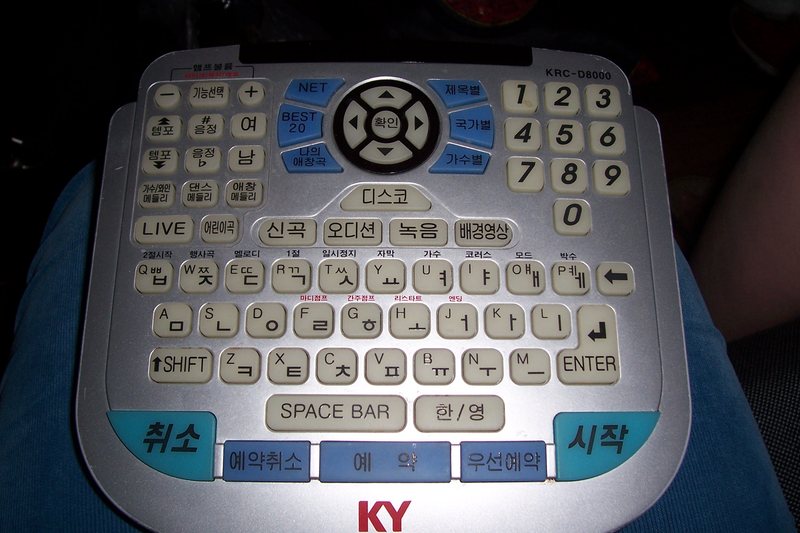
Type a song number on the number keys and press reserve, and it goes to the back of the queue. Press start instead and the current song stops and yours begins at once. When nothing is playing, enter a number, press start and the accompaniment comes straight on. A number entered by mistake is removed with the cancel button. What exactly cancel removes from the queue varies slightly by machine, so follow the on-screen prompt. If you want to cut off the song currently playing, pressing start to jump to the next one is quicker. Priority reserve, pressed after entering a number, slots that song at the very front of the queue. In a group it is the button for jumping the line, and among Koreans someone who presses it usually hears about it. Interlude skip jumps over the long instrumental passage in the middle of a song. Whether you pay by time or by song, an interlude is money draining away, so people use it often. Key goes up or down one step at a time with the up and down buttons, and the male and female buttons switch to a key suited to that voice range in one press. Kumyoung's own guide describes this as changing the pitch with the up and down buttons and having the male and female buttons automatically adjust to the key value for that sex. Tempo speeds up and slows down the same way. Echo and microphone volume are on the remote and also on dials on the amplifier on the wall. If the microphone only feeds back and gives no voice, the microphone volume on the amplifier is usually turned down to 0. A score appears when the song ends. Treat it as a toy.
- 6
How to find English songs
The machines you meet in a noraebang are mostly from two companies, TJ Media and Kumyoung Entertainment. The same song has a different number at each, so check the logo on the screen when you enter and look up that company's number. Both let you search on the web. TJ Media's song search takes title, artist, lyricist, composer or song number, and its notice says it does not support foreign songs other than Korean pop, English pop and Japanese songs. In other words, English songs are filed under pop and can be searched. Kumyoung's KYSing search takes title, artist, song number or lyrics. Type the original English title and the original artist's name as they are. In the thick book in the room, foreign songs are grouped in their own section, so open that part and look under the original title. If the machine itself has a search function, switch the input from Korean to English and enter the artist's name. The surest method of all is to write down both companies' numbers for every song you want before you walk in.
- 7
What the screen shows when time runs out
In a timed room, as the end approaches the screen shows the remaining time or a notice. When the accompaniment stops after that, the time is up. Sometimes the counter adds extra time before it runs out, and this extra is called service. Service is owner's discretion and appears nowhere in the law. It tends to be generous in the quiet daytime and may not exist in the busy evening. Be grateful if you get it and there is no basis for complaint if you do not. To keep singing, ask for an extension over the intercom in the room or at the counter. The unit and price of an extension differ from shop to shop, so ask then. Pay at the counter, where cards are almost always accepted. There is no tipping. A coin noraebang skips this whole procedure. When the songs run out, that is the end, and to continue you feed in more bills. Put the microphone back where it was, leave the door open on your way out, and you have checked out. Remember one time calculation before you go. A singing practice room may admit minors only between 9 a.m. and 10 p.m., so past that hour a family group may have to give up the room. The details are in the traps below.
Watch it happen
Videos other people made, picked because they show a part of this guide that words cannot. They are not our sources: the rules and figures above come from the official pages listed at the end.
Going To A Korean Karaoke in Seoul (Noraebang) | Types of Karaoke, How To Use Them & Much More
Channel: How Is Korea, English narration, auto-generated English subtitles
Separates the coin room from the room you rent by the hour, which is the choice you make at the door and the one that decides what you pay.
How to Use a Korean Karaoke Remote (Karaoke 101)
Channel: BUSANSaeki, English narration, auto-generated English subtitles
Just the remote, button by button. It is the object in the room that nobody explains and the reason people give up before the first song.
The Korean words
- 노래연습장norae yeonseupjang, singing practice room (the legal business category for noraebang)
- The business name defined by law. It appears on the registration certificate and the sign. Alcohol and hostesses are banned there.
- 코인노래방koin noraebang, coin karaoke booth, paid per song
- A booth for one or two people where feeding in bills buys songs. You never pass a counter.
- 예약yeyak, queue a song
- Enter a number and press this button to add the song to the back of the queue.
- 우선예약useon yeyak, priority queue, puts the song at the front
- The button that slots a song at the front of the queue. In a group, ask before you use it.
- 간주점프ganju jeompeu, skip the instrumental break
- Jumps over the instrumental passage in the middle of a song. The button that saves time.
- 음정eumjeong, key (pitch) adjustment
- The up and down buttons move it a half step at a time. The male and female buttons switch to that range's key in one press.
- 서비스seobiseu, free extra time the owner adds
- Extra time the owner adds to a timed room. It is discretion, not law, so it may not come.
- 청소년실cheongsonyeonsil, youth room, the only room minors may use
- A room minors are allowed into. A youth room sign is fixed to its door.
Easy to miss
- Follow someone who approaches you on the street offering a noraebang and the place is very likely not a singing practice room. Soliciting is banned by law for singing practice rooms, and a place with alcohol and a hostess is an entertainment bar where drink and hostess charges are billed on top of the room. Before you go in, check the sign for the words singing practice room.
- Bringing alcohol into a singing practice room is a problem too. The owner may not turn a blind eye to customers bringing in alcohol, and it is the owner who is punished if they do. If you walk in with beer from a convenience store, being stopped at the counter is the normal outcome.
- Minors may enter only between 9 a.m. and 10 p.m., and only into the youth room of a shop that has one. A minor here means a person under 19, excluding anyone who has reached 1 January of the year they turn 19, which does not match the adult age used abroad. The exceptions to the two restrictions sit in different provisions. The time limit lifts when the minor is accompanied by someone in a position to supervise them, such as an adult relative or a school teacher. The youth room limit lifts when a parent or other guardian comes along. Either way, the owner makes the call after checking ID. If you are with your children, leave before 10 p.m. or have an adult stay in the same room to the end.
- TJ and Kumyoung song numbers are different. If you brought only one company's numbers and the machine in the room is the other company's, your list is useless. Write down both, or search after you have seen the logo in the room.
- Priority reserve is the button that puts your song ahead of everyone else's. Alone it causes no problem, but press it unknowingly in a group and you have jumped the queue. When Korean friends laugh and protest, this button is why.
- Service time is not a right. The previous customer getting more does not mean you get it, and the owner can refuse if you ask after the time has ended. If you need more time, do not wait for service. Ask for an extension.
You can skip this if
- If what you want is to drink while you sing, this is not the guide. That venue is a singing bar or an entertainment bar under the Food Sanitation Act, a wholly different world in pricing, age limits and risk. This guide goes only as far as how to avoid those bars.
- Home karaoke systems and smartphone singing apps are not covered. An app needs no room, so it has nothing to do with the room booking, pricing and youth time limits this guide describes.
- Anyone planning to buy a karaoke machine or open a shop is not this guide's reader either. Registration procedures and facility standards are in the Enforcement Rule, and the right place to ask is the city, county or district office with jurisdiction.
Where this comes from
- Music Industry Promotion Act (음악산업진흥에 관한 법률) (Korean Law Information Center, Ministry of Government Legislation)
- Enforcement Decree of the Music Industry Promotion Act (음악산업진흥에 관한 법률 시행령) (Korean Law Information Center, Ministry of Government Legislation)
- Enforcement Rule of the Music Industry Promotion Act (음악산업진흥에 관한 법률 시행규칙) (Korean Law Information Center, Ministry of Government Legislation)
- Youth Protection Act (청소년 보호법) (Korean Law Information Center, Ministry of Government Legislation)
- Enforcement Decree of the Food Sanitation Act (식품위생법 시행령) (Korean Law Information Center, Ministry of Government Legislation)
- Fair Trade Commission (공정거래위원회) decision 약식2024-010 on the trade association conduct of the Pohang Singing Practice Room Business Association (포항시노래연습장업협회) (reproduced on CaseNote)
- Song search (TJ Media)
- Song search (Kumyoung Entertainment, KYSing)
Rules, fees and deadlines change and depend on your exact case. Please confirm the details with the official sources before you act.