
The short version
Seoul has plenty of places where you can sit for hours without paying.
The libraries that are famous in photographs are not the ones where you get work done, and each one differs on whether you can simply walk in or need to register first.
Deadlines that matter
Closing days
By when: Seoul Metropolitan Library every Monday, National Library on the second and fourth Monday
If you miss it: You cannot use it that day. Starfield Library has no closing day and covers the gap.
Right now
- 1If you only want to read on site rather than borrow, most public libraries let you walk in without showing anything.
- 2The National Library of Korea is for ages 16 and over, and closes on the second and fourth Monday of each month.
- 3Seoul Metropolitan Library closes on Mondays. Walking to City Hall on a Monday and turning back is a common mistake.
Getting there
From Incheon Airport Terminal 1 or 2 (just after landing)
Take the airport railroad all-stop train to the last stop, Seoul Station. Change there to line 1 and ride one stop toward City Hall and Jongno 3-ga, getting off at City Hall station. Leave by exit 5 and the old Seoul City Hall building is the library.
- How long:
- About 1 hour 20 minutes to 1 hour 30 minutes (estimate)
The all-stop train takes a transit card; only the Express train needs a separate ticket and fare (18,500 won from Terminal 1, 19,100 won from Terminal 2). Seoul Metropolitan Library closes Mondays and public holidays.
From Seoul Station (KTX, airport railroad, or downtown)
At Seoul Station on line 4, ride three stops toward Myeongdong (trains bound for Danggogae or Jinjeop) and change at Chungmuro to line 3 toward Ogeum. Eight stops later, leave Express Bus Terminal station by exit 5, turn left and walk about 10 minutes to the main gate of the National Library of Korea.
- How long:
- About 45 to 55 minutes (estimate)
The National Library of Korea is for ages 16 and over and closes on the second and fourth Monday of each month. It opens 09:00 to 18:00, and until 21:00 on Wednesdays.
From Hongik University station (where lodgings cluster)
At Hongik Univ. station on line 2, board a train toward Hapjeong and Dangsan, the outer loop. Ride twenty stops without changing and get off at Samseong station. Take the passage at exits 5 and 6 into COEX Mall; Starfield Library is in the central plaza.
- How long:
- About 50 minutes to 1 hour (estimate)
The inner loop also reaches Samseong, but it goes three stops further around. Starfield Library opens at 10:30 and closes at 22:00.
From Seoul Metropolitan Library, closed on a Monday
From the line 2 platform at City Hall station, take a train toward Euljiro 1-ga, the inner loop. Ride eighteen stops without changing, get off at Samseong station and go into COEX Mall through the passage by exits 5 and 6.
- How long:
- About 45 to 55 minutes (estimate)
Starfield Library has no closing day, which makes it the Monday alternative. If that Monday is not the second or fourth of the month, the National Library of Korea is open too.
What to have ready
- ID: Needed to borrow or to register. Bring your residence card or passport.
- Earphones: The more open and free the space, the more noise carries.
- A layer: Reading rooms are usually kept cool.
Phrases you can copy and paste
Step by step
The route on a map
- 1
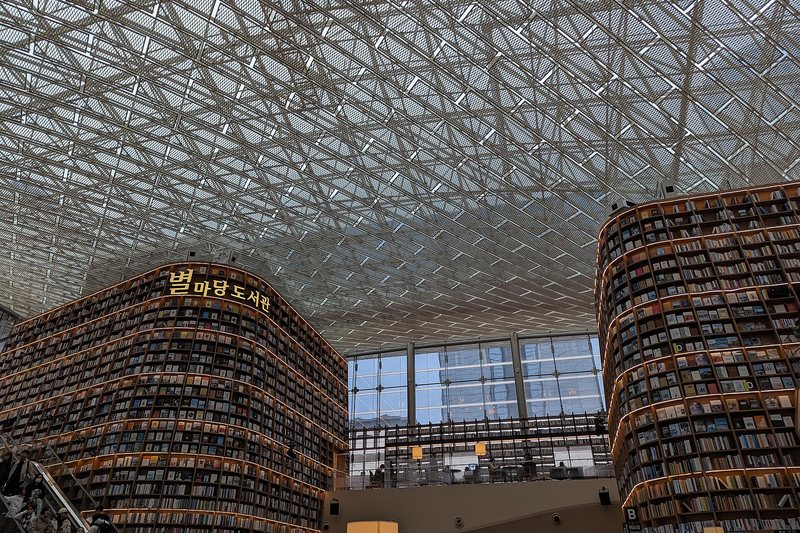
Starfield Library (COEX)
- Where:
- Samseong station on line 2, basement level 1 of Starfield COEX Mall
- How long:
- 10:30 to 22:00, open every day
- Cost:
- Free
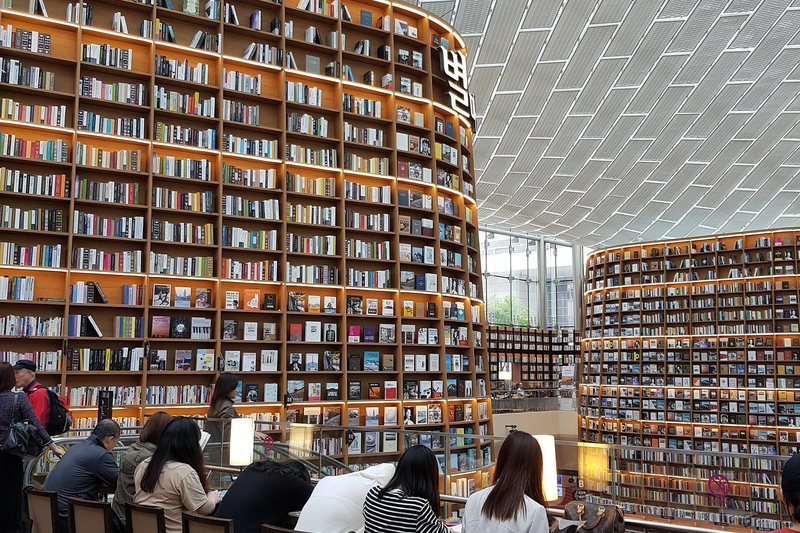
An open hall with shelves running up to the ceiling, which is how most people meet it, through a photograph. It sits in the middle of a shopping mall with people walking through constantly, so it is not the place for quiet concentration. What it is good for is late opening and never closing: browsing in the evening, or filling the gap between two appointments. You can take books off the shelves and read them there, but nothing is lent out.
513 Yeongdong-daero, Gangnam-gu, Seoul, South Korea
- 2
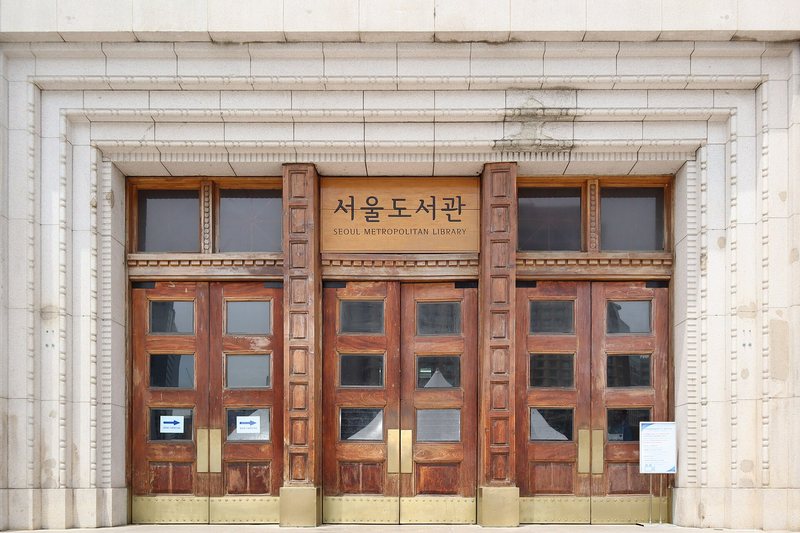
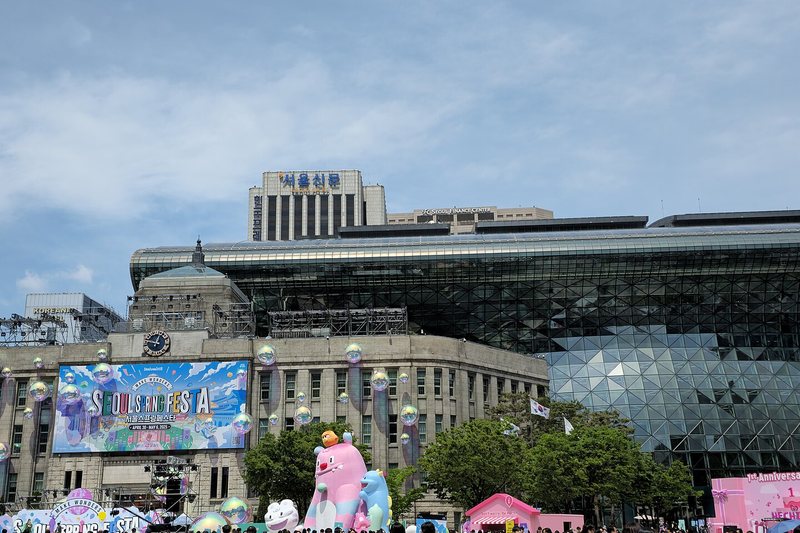
Seoul Metropolitan Library (City Hall)
- Where:
- City Hall station on lines 1 and 2, in the old Seoul City Hall building
- How long:
- Tuesday to Friday 09:00 to 21:00, Saturday and Sunday 09:00 to 18:00. Closed Mondays and public holidays
- Cost:
- Free
Reading the collection on site is open to anyone. Membership is only needed for borrowing, reservations and the preservation collection. To register you need identification, and a residence card or domestic residence report is accepted. A passport alone does not show an address, so you will be asked for a document that confirms where you live. The general reading rooms run until nine in the evening, which makes them usable after work, while some rooms such as the digital and world collections close at six on weekdays. The building itself, the former city hall, is worth the visit.
Filmed here: Gentleman
110 Sejong-daero, Jung-gu, Seoul, South Korea
- 3
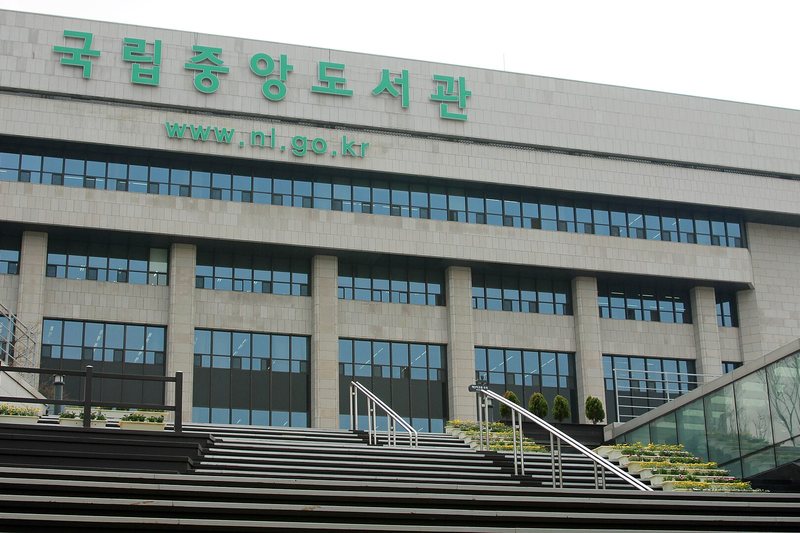
National Library of Korea (Seocho)
- Where:
- Walk from Express Bus Terminal station on lines 3, 7 and 9
- How long:
- 09:00 to 18:00, and until 21:00 on Wednesdays. Closed on the second and fourth Monday of each month
- Cost:
- Free
The largest collection in the country and the best of these for sitting still and working for a long stretch. There are conditions. You must be 16 or over, and you need a user card to access the collection. The card is issued at the user registration desk on the first floor when you bring identification, and registration is also possible online. If you do not have Korean identity verification methods such as a local mobile number, you can still register in person with your ID. Material stays inside the building and cannot be taken out.
201 Banpo-daero, Seocho-gu, Seoul, South Korea
- 4
If you would rather pay and be sure of a seat, use a study cafe
- Cost:
- Charged by time. Rates vary by branch
Every neighbourhood has one. Most run unstaffed: you pick a seat at the machine by the door, pay for a block of time and go in. Silent seats and seats where you can take a call are separated, and some branches stay open very late or around the clock. Unlike a library you can secure a seat without planning ahead, and the longer you stay the better the value compared with a cafe. University libraries are mostly closed to people outside the university, so it is better not to count on those.
Watch it happen
Videos other people made, picked because they show a part of this guide that words cannot. They are not our sources: the rules and figures above come from the official pages listed at the end.
스터디 카페 무인 키오스크 입장, 걱정마세요.
Channel: 달성하리☆, Korean, no English subtitles. The value is the kiosk screen
Just the unmanned kiosk at the door, which is the whole barrier: there is nobody to ask, and the screen decides your seat and your hours before you are inside.
스터디 카페가 처음인 사람들을 위한 카페 이용 안내서
Channel: 세븐시스템, Korean, no English subtitles. The value is the screen
Covers what happens after the kiosk: which seats are which, what the rules about noise and food are, and how leaving works.
The Korean words
- 열람실yeollamsil, reading room
- The room where you sit and read. Quiet is the default.
- 대출daechul, borrowing
- Taking a book out. Requires membership.
- 휴관hyugwan, closed today
- The sign meaning the library is not open that day.
- 이용증iyongjeung, library card
- The card issued so you can use the collection.
- 스터디카페seuteodi kape, study cafe
- A paid study space where you buy a seat by the hour.
Easy to miss
- Plans made for a Monday tend to fail. Public library closing days cluster on Mondays.
- The library that photographs well and the library you can work in are not the same one. Starfield Library is an open, noisy space.
- A passport on its own is sometimes not enough to register. You also need something showing your address.
- The National Library is not open to under 16s as a rule.
You can skip this if
- If you are looking for a place to work on a laptop for hours, power sockets and seating rules vary so much by cafe that the cafe question is worth answering separately.
- If you want to buy books, a large bookshop suits you better. Library material cannot leave the building.
When it is time for a person
- If you are studying or preparing for an exam in Korea, someone who knows local library registration and study support programmes is worth having.
Where this comes from
Rules, fees and deadlines change and depend on your exact case. Please confirm the details with the official sources before you act.